
Lost dog? How drone search teams help, and what to do first (with Ayrshire Drone Dog Rescue)
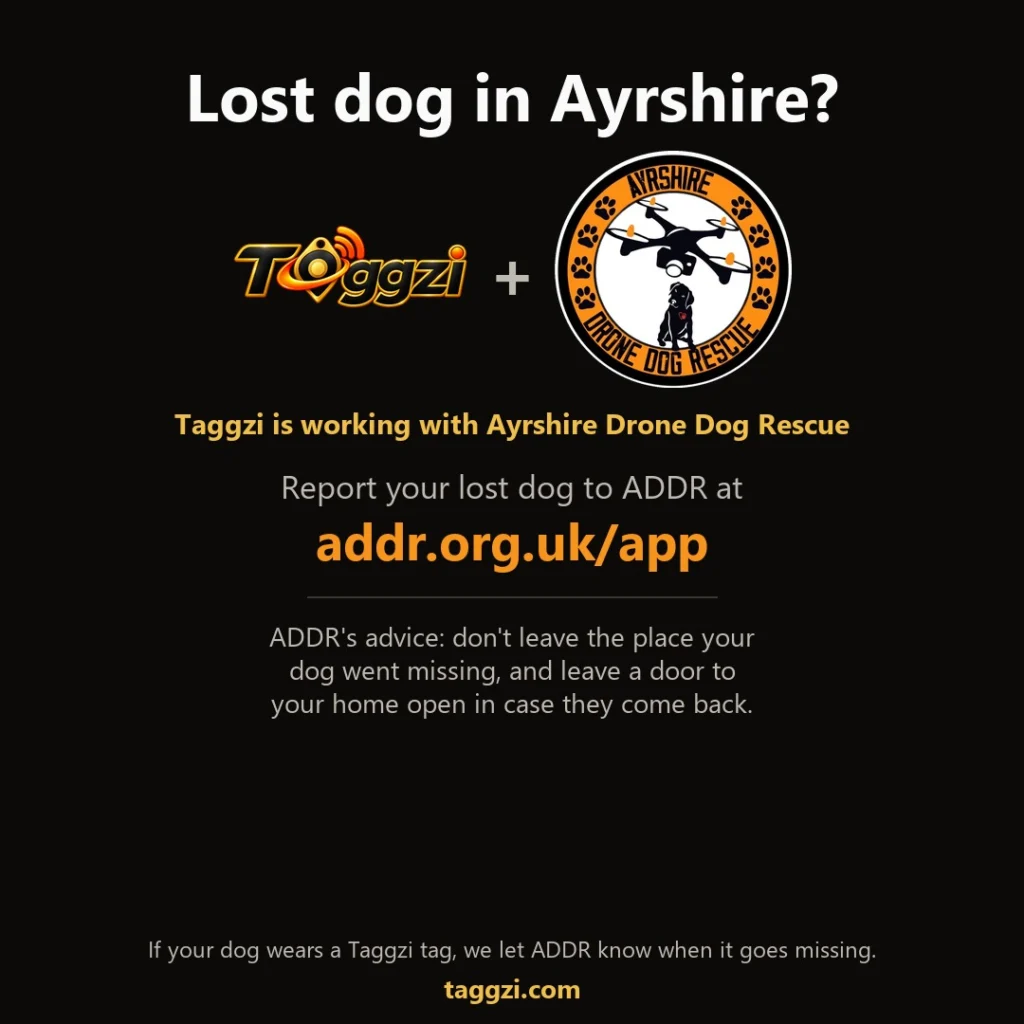
If your dog goes missing, keep the place they went missing calm and someone they trust nearby, and don’t chase, call or whistle. Ask people to report sightings privately, with the exact place, time and direction. Report your dog missing to 101, local vets, the dog warden and the microchip database company. Contact a reputable search team as soon as possible: in Ayrshire, that’s Ayrshire Drone Dog Rescue.
This guide is written with the help of Ayrshire Drone Dog Rescue (ADDR), a volunteer team founded by Liz in June 2022. They look for missing dogs across Ayrshire using drones, thermal imaging scopes, tracking dogs and careful planning. Most of the advice below comes from ADDR’s own knowledge base at addr.org.uk/learn, and we’ve marked where it does. Thank you to Liz and the team for letting us share it.
For the full first-24-hours checklist, see our guide Lost dog UK: what to do in the first 24 hours. For more on frightened dogs, see Lost a nervous dog? Why nobody should chase them.
What should you do in the first few hours?
Stay put, keep things quiet and report your dog. ADDR’s advice for the first hours:
- Keep someone at the missing point. ADDR says dogs can come back, sometimes hours later, once the area is quieter. Leave a worn, unwashed item of clothing from the person the dog is closest to, tied down.
- If your dog got out at home, check the house, garden and sheds first. If it’s safe, leave their usual door open with a clear way back in, and ask neighbours to check their doorbell cameras.
- Don’t put food out everywhere. ADDR may later set up one feeding point watched by a camera. Food in lots of places makes the dog’s pattern harder to read.
- Don’t organise a big search party. Lots of people walking, calling and searching can push a frightened dog further away. If a planned search is needed, ADDR will say how and where.
- Stay contactable. Keep your phone charged and loud.
Why shouldn’t you call or chase a frightened dog?
Because a frightened dog may run from anyone, even you. ADDR explains that a lost dog can go into “flight” or “survival” mode, where avoiding anything that feels like a threat comes first. A dog who would normally run to you may run the other way. They haven’t forgotten you. Fear overrides their normal response.
So running towards them, calling, shouting or whistling can make them bolt, sometimes across a road or railway. As ADDR puts it: “Sometimes doing less is actually helping more.”
If you see your dog (ADDR’s advice):
- Don’t approach, chase, call or whistle, even as the owner.
- Note the exact location, time and direction of travel. Drop a pin on Google Maps or use what3words.
- Take a photo or video only from where you are. Don’t follow them on foot or by car.
- At night, use a red or green light rather than a bright white torch.
Why keep sightings off social media?
Because a public post can bring well-meaning people to the exact spot, and the dog moves on. ADDR asks everyone to share the official missing poster, but to report live sightings privately to the team or the owner. In their words: “Share the poster — not the live location.”
ADDR gives three reasons:
- People turn up. Searching and calling can push a dog out of an area where it was starting to settle.
- The team needs a pattern. Accurate sightings (place, time, direction, behaviour) show where a dog is travelling and returning. That decides whether cameras, a feeding station, a drone or a humane trap make sense.
- Safety. A public location can reveal a vulnerable dog to someone with the wrong intentions.
ADDR also keeps camera, feeding station and trap locations private. Photos can give a place away through signs or landmarks. Even a sighting that seems unimportant is worth reporting.
How do drone and thermal searches work?
A thermal camera picks up differences in temperature, so a dog can show up warmer than its surroundings. ADDR’s drones carry thermal cameras to check fields, woodland and hard-to-reach ground, without anyone chasing or cornering the dog.
ADDR is honest about the limits:
- Thermal can’t see through trees, buildings or dense vegetation. Long grass and bracken can hide a dog too.
- Deer, foxes, sheep and warm surfaces also show up, so the pilot has to interpret what they see.
- Weather and drone flying rules can stop a flight.
- No detection doesn’t mean the dog isn’t there. In ADDR’s words, it means “the dog was not detected during that flight”.
So ADDR doesn’t always fly straight away. Each case starts with an assessment of the dog, sightings, hazards, terrain and weather. The plan might be a drone, a camera on a feeding station, a tracking dog, a humane trap or a planned ground search. Or simply giving the dog space while sightings come in. In ADDR’s words: “No egos. No competition. The dog’s safety comes first.”
How do you report a missing dog to ADDR in Ayrshire?
The owner reports the dog directly. ADDR doesn’t cold-contact owners, and a report isn’t published until the owner has been in touch.
- Report a missing dog: addr.org.uk/app (the ADDR app) or the web form at addr.org.uk/report. Say where and when, what happened, your dog’s temperament and any sightings.
- Seen a missing dog? Report it through the ADDR app or website, not in Facebook comments.
- Email: ayrshireddr@gmail.com · Facebook: facebook.com/AyrshireDDR
- Ayrshire dog wardens: North Ayrshire 01294 324339 · South Ayrshire 0300 123 0900 · East Ayrshire by email at environmentalhealth@east-ayrshire.gov.uk (council main line 01563 554400).
ADDR doesn’t charge owners. If another specialist team is already running a search, ADDR may step back: one team with one plan is safest for the dog.
What if you’re not in Ayrshire?
The same principles apply: stay calm, don’t chase, and report sightings privately. Then:
- Find one local lost-dog search team. ADDR explains that several teams giving different advice can lead to confusion for a worried owner and lengthen the time a dog is missing. One team with a structured plan is what’s needed.
- Tell the council’s dog warden. Every council in Great Britain must appoint an officer for stray dogs (Environmental Protection Act 1990, s.149). In England and Wales, a finder who can’t reach the owner must report the dog to the council (GOV.UK: Report a stray dog).
- Check your microchip details. All UK dogs must be microchipped and registered, and you must keep the details up to date with your database company (GOV.UK: Get your dog or cat microchipped; in Scotland, regulation 6 of the 2016 Regulations).
- Ring local vets and rescue centres. They can scan a found dog for a chip.
- List your dog on DogLost, which ADDR lists among its useful contacts. Near a railway, ADDR lists Network Rail: 0345 711 4141.
How Taggzi can help
Taggzi is a smart ID tag for your dog’s collar, not a tracker. It doesn’t show where your dog is. It helps a finder reach you:
- Tap or scan: a finder taps the tag with their phone or scans its QR code. Your dog’s profile opens so they can contact you, with no app needed.
- Lost Mode: switch it on and your dog’s profile shows they’re missing.
- Ayrshire (KA postcodes): if your dog is still lost 30 minutes after you turn on Lost Mode and was last seen in a KA postcode area, Taggzi sends the alert to ADDR. ADDR doesn’t contact owners unless you say it’s OK, so report your dog to ADDR yourself, or press “Allow ADDR to contact me” in your Lost Mode email.
A tag works alongside your dog’s microchip and the legal collar-and-tag requirement. It doesn’t replace them.
Support Ayrshire Drone Dog Rescue
ADDR is run by unpaid volunteers. Donations pay for equipment, cameras, running costs and prevention work. ADDR never asks an owner to donate before helping.
- Donate: addr.org.uk/donate
- Report a missing dog in Ayrshire: addr.org.uk/app