How NFC Pet Tags Work: A Simple Guide for Pet Owners
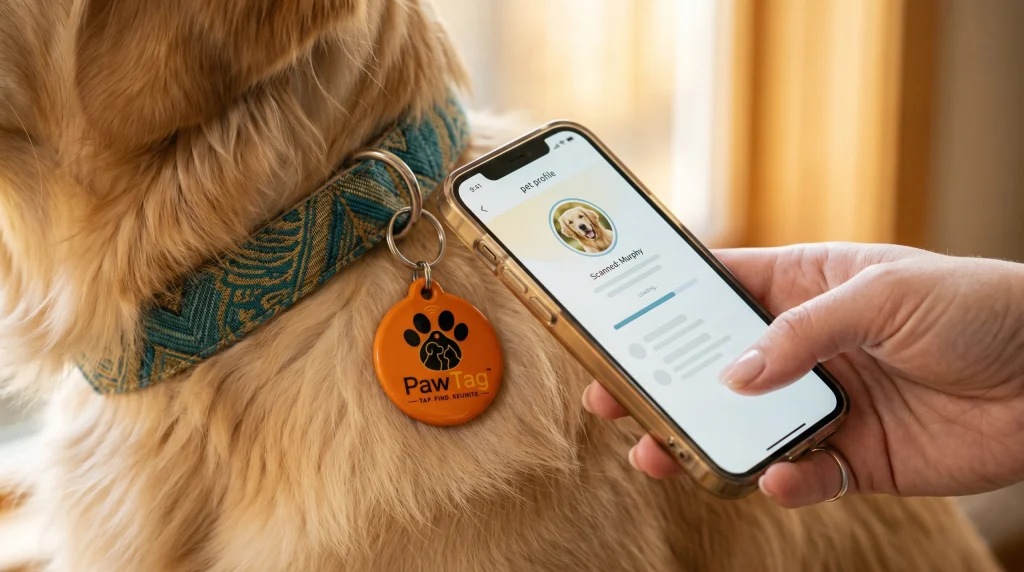
An NFC pet tag is a collar tag with a tiny chip inside. When someone holds a phone near it, the chip gives the phone a web address, and the phone opens your pet’s profile page — no app, no battery and nothing to charge. The technology sounds complicated, but using one is as simple as paying with a contactless card. Here’s how it works.
What is NFC?
NFC stands for Near Field Communication. It is the same short-range radio technology used in contactless bank cards and phone payments. According to the NFC Forum, the industry body behind the standard, NFC works at a frequency of 13.56 MHz over a typical range of up to 2 cm. Android’s developer guide describes it as needing “a distance of 4 cm or less” to connect. In practice, that means the finder touches the phone to the tag, or holds it very close.
The range is a feature, not a flaw: nobody can read the tag from across the street, and the finder’s phone only reacts when they deliberately tap it.
How can a tag with no battery work?
The NFC chip in a pet tag is passive. It has no battery of its own. When a phone comes close, the phone’s NFC reader creates a small radio field that powers the chip just long enough for it to send back what it stores — usually a web address, saved in a standard format called NDEF (NFC Data Exchange Format). That’s why an NFC tag never needs charging and can keep working for years.
What happens when someone taps the tag?
When a finder holds their phone near a Taggzi, the phone reads the web address and opens your pet’s profile page in its browser. No app required. No searching. Just tap and go.
The profile page shows:
- Your pet’s name and photo
- The contact details you choose to show
- A button to message you privately, and to call you if you show your number
- A way for the finder to tell you they’ve found or seen your pet
If your pet is marked as lost, the page switches to an emergency view with a big LOST banner and a map of recent scan locations.
Which phones can read an NFC pet tag?
Most modern smartphones have NFC. On an iPhone, Apple’s developer documentation says iPhone XS and later read NFC tags in the background, with no app: the phone shows a notification, and tapping it opens the page. The phone needs to be in use (screen on), and it won’t read a tag while the camera or Apple Pay is open or in Airplane mode.
On Android, NFC is built into most phones but can be switched off in settings. If it’s on, tapping the tag opens the page straight away.
How does a finder know what to do?
Most people have never tapped a pet tag before, so the tag tells them. A Taggzi tag is printed with “Scan me” and “Tap me” next to the QR code and the NFC symbol, along with taggzi.com. Someone who has found a dog in the park doesn’t need to know what NFC is: they see the words, hold up their phone, and your pet’s page opens.
What about QR codes?
Taggzi tags include both NFC and a QR code. The QR code works on phones that don’t have NFC or have it turned off, and can be scanned with the normal camera app from a short distance. QR codes follow an international standard (ISO/IEC 18004), so any phone camera can read them. Both methods open the same profile page.
Having both means your pet is covered whatever phone the finder has.
Why is this better than an engraved tag?
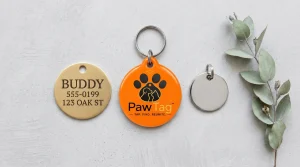
Engraved tags have two big problems. First, they wear down — the text can become hard to read after months of use. Second, your phone number might change, but the tag can’t be updated.
With a digital tag, your details live online and you can update them any time from your phone. New address? New number? Just log in and change it — no new tag needed. In the UK, dogs must still wear a tag with the owner’s name and address in public, so keep the engraved tag and add the smart tag alongside it.
Is it safe?
Yes. You control exactly what information is visible on the public profile. Your home address is optional and only shown if you choose to show it, and a finder can message you without seeing your phone number.
The tag only carries a web address — your pet’s details live in your Taggzi account, not on the chip. A finder’s phone reads the tag; it can’t change your pet’s details.
What does an NFC tag not do?
An NFC tag is not a GPS tracker. It can’t tell you where your pet is right now; it only works when someone has your pet in front of them and taps or scans the tag. With Taggzi Pro you get an instant alert when that happens, with the approximate location of the scan. If you want live tracking, use a GPS collar alongside it.
Taggzi Pro subscribers also earn a Verified Owner badge — shown in the app when collecting a found pet. It reassures finders that they’re handing back to the legitimate registered owner.